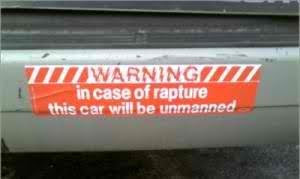
Years ago, some Christians used to put bumper stickers on their cars that said, “In case of Rapture, this car will be unmanned.”

Just when we thought Houston traffic couldn’t get any worse, imagine what would happen if the Rapture happened during rush hour. I have no doubt the Great Tribulation would begin on the West Loop!
Few Christian doctrines have generated more fascination, speculation, arguments, charts, novels, movies, and bizarre bumper stickers than the Rapture. And because our journey through Revelation at The Story is now taking us into some of the book’s most intense passages, I’ve been getting more questions about it lately.
So what exactly is the Rapture, and what does the Bible have to say about it?
What is the Rapture?
The word rapture doesn’t appear in most English translations of the Bible, but the concept certainly does. In 1 Thessalonians 4, the Apostle Paul describes what will happen when Jesus returns: “The Lord himself will come down from heaven, with a loud command, with the voice of the archangel and with the trumpet call of God, and the dead in Christ will rise first. After that, we who are still alive and are left will be caught up together with them in the clouds to meet the Lord in the air” (1 Thessalonians 4:16–17).
That phrase “caught up” is where we get our English word rapture. It comes through the Latin translation of Paul’s words and simply describes the future moment when believers who are still living on Earth will be gathered up to meet Jesus.
Contrary to what you may have heard, every faithful Christian believes in the Rapture in that basic sense. Christians may argue passionately about when it happens, how it relates to the Tribulation, and whether it should be distinguished from Christ’s final return, but the biblical promise itself is hard to miss: Jesus is coming back, the dead in Christ will rise, and believers who are still alive will be gathered to Him.
For Christians, the ultimate question about the Rapture isn’t if we’ll be taken up, but when.
Some Christians believe the Rapture will happen before the Great Tribulation begins. They often point to passages in which believers appear to be promised deliverance from God’s coming wrath, such as “God did not appoint us to suffer wrath” (1 Thessalonians 5:9) and Jesus’ promise to the church in Philadelphia, “I will also keep you from the hour of trial that is going to come on the whole world” (Revelation 3:10). Pre-Tribulation proponents also find it significant that the word church appears repeatedly in Revelation 1-3, but then disappears throughout the chapters describing the seals, trumpets, and bowls before reappearing later. That silence doesn’t prove the case for a pre-Tribulation Rapture, but it’s certainly worth noting.
Others believe Christians will remain on earth through at least part of the Tribulation before being gathered to Christ. Mid-Tribulation advocates often connect Paul’s statement that believers will be raised “at the last trumpet” (1 Corinthians 15:52) with the seventh trumpet of Revelation 11:15, and others point to the fact that Revelation clearly describes faithful believers enduring persecution during the Tribulation itself (Revelation 7:9-14; 13:7-10; 14:12). The challenge, of course, is determining whether those believers represent the Church as we know it today or unbelievers who come to faith during the Tribulation after being “left behind” in the Rapture.
Still others believe the “catching up” Paul describes in 1 Thessalonians 4 happens after the Tribulation, as part of Christ’s final, visible return. The strongest text supporting a post-Tribulation Rapture is probably Matthew 24, where Jesus says that “immediately after the distress of those days” the Son of Man will appear, the trumpet will sound, and His angels will “gather his elect from the four winds” (Matthew 24:29-31). That sequence sounds strikingly similar to Paul’s description of Christ descending from Heaven with a trumpet as believers are caught up to meet Him (1 Thessalonians 4:16-17).
In other words, faithful Christians are working with many of the same verses and reaching different conclusions about how it all fits together. That should probably make all of us a little more humble about our timelines.
If you’re wondering where I stand, the more I’ve studied the relevant passages, the more persuaded I’ve become that believers will probably be gathered to Christ before the worst of God’s judgments unfold – either pre- or mid-Tribulation.
I certainly hope I’m right. I would love nothing more than for every believer I know and love to be spared the horrors we’re reading about in Revelation. If Jesus wants to come get us before the locust demons show up, He’ll hear no objection from me.
But even though I lean toward a pre- or mid-Tribulation Rapture, I don’t find enough biblical support for it to teach it with total confidence. There are good arguments for this idea, but there are also passages that should give every pre- and mid-Tribber pause. Jesus spoke openly about His followers enduring persecution and tribulation before His return, and throughout Revelation, God’s people are repeatedly called to endure faithfully in the face of suffering.
Revelation 13:10 puts it plainly: “This calls for patient endurance and faithfulness on the part of God’s people.”
So…what if we’re still here?
What if God’s plan is not to remove His people before every period of suffering, but to sustain us faithfully through some or all of it?
That possibility shouldn’t surprise anyone who’s read much of the Bible. God has never promised His people a life free from hardship. In fact, some of the Bible’s greatest stories are about God meeting His people in the middle of circumstances He did not immediately remove.
God didn’t keep Daniel out of the lions’ den. He protected him inside it. He didn’t stop Shadrach, Meshach, and Abednego from being thrown into the furnace. He met them in the fire. He didn’t remove the Israelites from Egypt before every plague fell. He encouraged them to remain faithful as His judgments unfolded.
And Jesus never told His disciples, “Follow Me and nothing terrible will ever happen to you.” He said almost the opposite: “In this world you will have trouble.” But He immediately followed that warning with a promise: “Take heart! I have overcome the world” (John 16:33).
That’s why I think Christians need to be careful about becoming more fascinated with escaping suffering than with enduring faithfully. Because sometimes our fixation on the Rapture can quietly become an obsession with getting out. And once escaping becomes the focus, speculation usually isn’t far behind.
When will Jesus remove us? How bad will things get before He comes? Which trumpet are we on? Is this politician the Antichrist? Is that technology the Mark of the Beast? And somewhere in the middle of all that speculation, it’s possible to lose sight of what Jesus actually emphasized whenever He talked about His return.
He said, “Keep watch, because you do not know on what day your Lord will come” (Matthew 24:42).
In other words, Jesus was far more concerned with the condition of His disciples’ hearts than the accuracy of their end-times charts. He wants His people awake, sober-minded, and faithful – not merely informed about prophecy, but formed by it.
That means living today in such a way that, if Jesus returned tomorrow, you wouldn’t need a few extra weeks to get your life in order. It means forgiving the person you’ve hesitated to forgive, dealing honestly with the sins you’ve been hiding, loving your family well, sharing your faith courageously, refusing to compromise when obedience becomes costly, and making sure your relationship with Jesus is more than a casual, Sunday morning affair.
And if the Tribulation begins before the Church is removed, readiness will mean something else too. It will mean trusting God when the world gets frightening, remaining faithful when following Jesus becomes wildly unpopular or even dangerous, and refusing to bow to whatever cultural pressure demands our allegiance.
That’s why my approach to the timing of the Rapture is pretty simple: We should hope for the best, while preparing for the worst.
I hope Christians are gathered to Jesus before the darkest days described in Revelation. I think there are good reasons to believe we may be. But if that’s not how it unfolds, I don’t want our faith collapsing because God didn’t follow our preferred timeline.
I would much rather see the people of The Story be pleasantly surprised by a pre-Tribulation Rapture – and rejoicing all the way to Heaven – than sorely disappointed by a post-Tribulation one – and spiritually unprepared to endure life on earth.
So yes, I hope the Church is spared the worst of what is coming. But even more than that, I hope that whenever Jesus comes for us, He finds us faithful and prepared, because the most important question won’t be whether we’ve correctly predicted when He’ll come.
It’s whether we’ll be ready when He does.
Grace & Truth,
Pastor Eric