

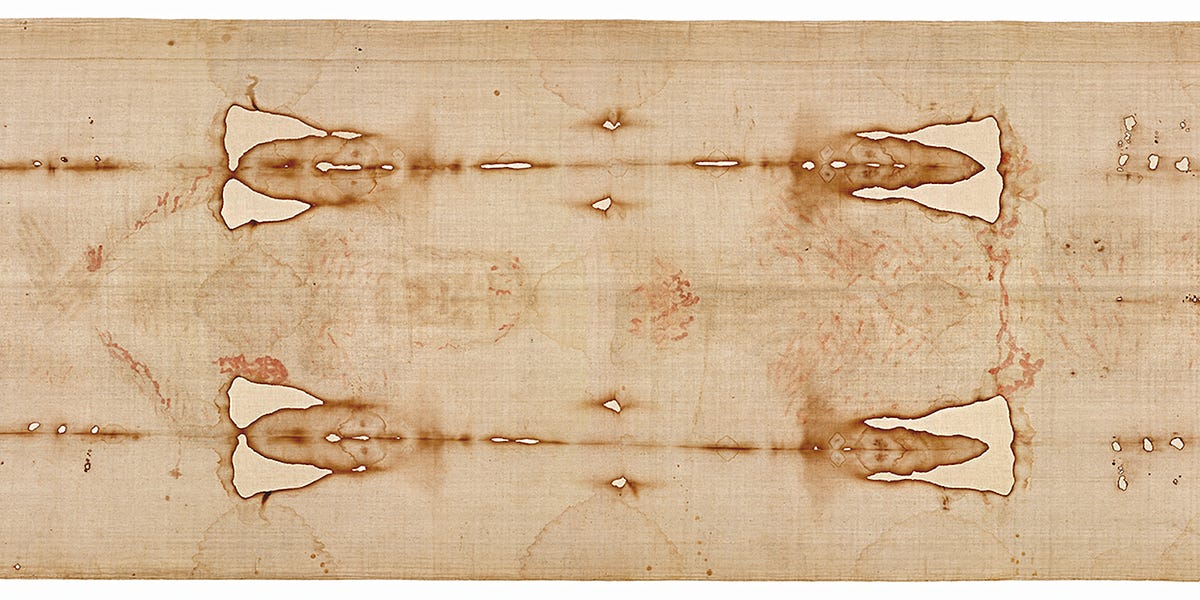
Until fairly recently, I thought the Shroud of Turin was kind of ridiculous.
Mind you, I hadn’t actually studied it enough to know why it was ridiculous. I just assumed it was one of those medieval Catholic relics that belonged in the same category as a splinter from Noah’s Ark kept hidden in the Vatican basement or the calcified finger bone of Saint Whoever.
Very scholarly of me.
During a recent conversation on the Maybe God Podcast with my friend Dr. Jeremiah Johnston, I admitted that for years I wasn’t even a good skeptic about the Shroud because a good skeptic investigates before reaching a conclusion. I had basically skipped that part and gone straight to cynicism.

Then I actually started looking at the evidence, and now the Shroud has my attention.
If you’re unfamiliar with it, the Shroud is a large linen cloth, about fourteen feet long and three-and-a-half feet wide, bearing the faint front-and-back image of a man who appears to have been crucified. For centuries, Christians have claimed that it may be the burial cloth in which the body of Jesus was wrapped after His crucifixion.
Is it?
I don’t know, and anyone who tells you that the question is “settled science” in either direction is probably selling something. But what I’ve discovered is that the Shroud is considerably harder to explain than I once assumed.
The Gospel of John tells us that Joseph of Arimathea and Nicodemus took Jesus’ body down from the cross and wrapped it in linen for burial (John 19:38-40). Then, on Easter morning, Peter and John (who was super-fast, by the way) ran into the empty tomb and found the burial cloths lying there, with Jesus’ body gone (John 20:3-8).
Most of us have read those verses dozens of times, but the Shroud raises two provocative questions that we often fail to consider:
- Why do all four Gospels mention Jesus’ burial cloths, a strange, seemingly unnecessary detail – unless, of course, the first-generation Christians had them in their possession? (Matt. 27:59, Mark 15:46, Luke 24:12, John 20:5-7)
- What if Jesus’ burial cloths were so sacred to his followers that Christians managed to keep them safe for 2,000 years?
Before you roll your eyes the way I used to, consider a few things.
First, the image on the Shroud does not behave like a normal painting. In 1978, a team of scientists known as the Shroud of Turin Research Project, or STURP, was given extraordinary access to the cloth. The group included physicists, chemists, engineers, and imaging specialists, many of whom arrived expecting to expose a clever work of art. Instead, their analysis found no convincing evidence that the body image had been produced by conventional paint, dye, or pigment. The image is astonishingly superficial, affecting only the outermost portions of the linen fibers rather than soaking through the cloth like ordinary paint or ink.
That’s strange enough, but in 1898, an Italian photographer named Secondo Pia discovered something even stranger. When he photographed the Shroud and developed the plate, the photographic negative revealed a much more natural-looking image of the crucified man’s face and body than the cloth itself. In a sense, the image on the Shroud behaves like a photographic negative centuries before anybody had invented photography.

The photographic negative, with the back side (left) and front side (right)
Later researchers discovered that the image also contains unusual three-dimensional information. When photographs of the Shroud were analyzed using an instrument called a VP-8 image analyzer, variations in the intensity of the image corresponded in unusual ways to apparent distances between the cloth and the body. During our conversation, Dr. Johnston described how this particular feature helped spark the modern scientific investigation of the Shroud.

The VP-8 image scan (left) and corresponding 3-D body model
Then there’s the man pictured on the cloth. He appears to have been brutally scourged. There are wounds consistent with Roman crucifixion, including puncture injuries near the wrists and feet, trauma around the scalp, and a large wound in the side with evidence of blood and fluid emissions. There are also abrasions across the shoulders that some researchers have connected with the carrying of a crossbeam. The blood on the shroud has been tested, and it is 100% human blood, type AB, with very high levels of bilirubin – indicating high levels of bodily trauma prior to death.

In our conversation, Dr. Johnston pointed out just how closely the image corresponds with the kind of death described in the Gospel accounts of the crucifixion: the scourging, the beatings (the man in the Shroud had a broken nose), the crown of thorns, the crossbeam, the blood, etc.
Christians can become so accustomed to seeing polished crosses hanging around our necks and mounted on sanctuary walls that we forget what the cross actually was: horrific, institutionalized torture. Whether or not the Shroud ultimately proves authentic, it forces us to look again at the physical horror of what Jesus endured.
Of course, there have been some objections to the Shroud’s authenticity, and Christians should be willing to face it honestly. In 1988, three laboratories performed radiocarbon testing on a small sample of the cloth and dated it to the medieval period, roughly A.D. 1260–1390. More recently, however, researchers have challenged the methodology and consistency of the 1988 radiocarbon testing, and others have used different techniques that suggest a much earlier date. Dr. Johnston went into great detail on these questions over on Maybe God.
Perhaps the most fascinating question of all might be this: How was the image actually made?
We still don’t know. Scientists have proposed chemical reactions, contact processes, artistic techniques, and radiation. Italian physicist Paolo Di Lazzaro and colleagues even experimented with extremely short bursts of ultraviolet laser light and were able, under very specific conditions, to produce on small pieces of linen a superficial discoloration resembling certain microscopic characteristics of the Shroud image. Dr. Johnston described on Maybe God how that kind of effect would be virtually impossible to produce – especially in the Middle Ages – without scorching the cloth.
That experiment doesn’t prove that a supernatural burst of Resurrection energy created the image, but it does leave us with a stubborn fact: after decades of sophisticated scientific investigation, we still do not have a universally accepted explanation for how the image on this cloth was formed.
One thing is certain, when we’re looking at the Shroud of Turin, we’re not looking at some medieval artist’s interpretation of Good Friday. We’re looking at physical traces left behind by a crucified man.
“But why does the Shroud even matter?”
I hear Christians ask this all the time. We already have all the evidence we need in the Bible. Why do we need anything more than the apostolic witness about Jesus’ resurrection that’s found in Scripture?
I’m sympathetic to this argument. However, as someone who came to faith as a result of extra-biblical evidence for the resurrection, I believe that archaeological discoveries like the Shroud, the Dead Sea Scrolls, the James Ossuary, and the first-century house-church graffiti in Capernaum* hold enormous explanatory power that can open the minds of ardent skeptics who would otherwise be slow to give Scripture a second thought.
*Dr. Johnston and I discussed those other discoveries and more over on… you guessed it… Maybe God!
That’s why conversations about things like the Shroud matter to me. This modern world is full of people who are genuinely curious about Jesus but who don’t trust what the Bible says. For many of them, Scripture itself is the thing under suspicion.
Maybe you’re one of them – or maybe that describes someone you live with – someone who grew up around Christianity, but somewhere along the way decided that faith belonged in the category of feelings, while facts belonged somewhere else. Maybe you admire Jesus but don’t trust the people who wrote about Him all those years ago (or the people who talk about him today).
Maybe you assume that archaeology, science, and serious historical inquiry are threats to Christianity rather than possible allies in the search for truth.
If that’s you, I understand. I agreed with you for years. And I would never tell you that the Shroud of Turin, the James Ossuary, or the Dead Sea Scrolls prove beyond all doubt that Jesus is Lord. But evidence can give an honest skeptic a reason to look again.
That’s what happened to me: the evidence outside the Bible eventually made me wonder whether I had underestimated the evidence inside it.
And once I began reading the Gospels again, not as religious propaganda but as ancient testimony that deserved to be taken seriously, everything began to change. The earliest Christians didn’t say, “We had a beautiful spiritual experience that helped us cope with our grief.” They claimed that Jesus died, was buried, and then he rose again.
Those are real, historical claims made by multiple eyewitnesses. Those claims are either true or they aren’t, and Christianity has always been unusually vulnerable in that respect. The Apostle Paul himself said that if Christ has not been raised, “your faith is futile” (1 Corinthians 15:17). In other words, Christianity invites investigation because it ultimately depends upon something we believe actually happened in history.
So no, my faith does not depend on a fourteen-foot piece of cloth in Turin, Italy. If the Shroud were conclusively proven fraudulent tomorrow, Jesus would still be Lord and the historical case for His Resurrection would remain.
But what if the Shroud is for real? What if this strange, ancient burial cloth really did wrap the body of a crucified Jewish man in the first century? And what if that man really was Jesus?
I’m not ready to tell you that I know the answer.
But I’ve stopped laughing at the question.
—
For additional information on the Shroud, I recommend these two videos from non-Christian skeptics:
The Shroud and the Jew – Dr. Barrie Schwartz
Shroud Studies – Dr. John Campbell
The Shroud and the Jew – Dr. Barrie Schwartz
Shroud Studies – Dr. John Campbell
